

Una historia de las invasiones y Fibazi
by ZihuaRob 
 , Zihuatanejo, México, Tuesday, July 30, 2013, 12:14 (4860 days ago)
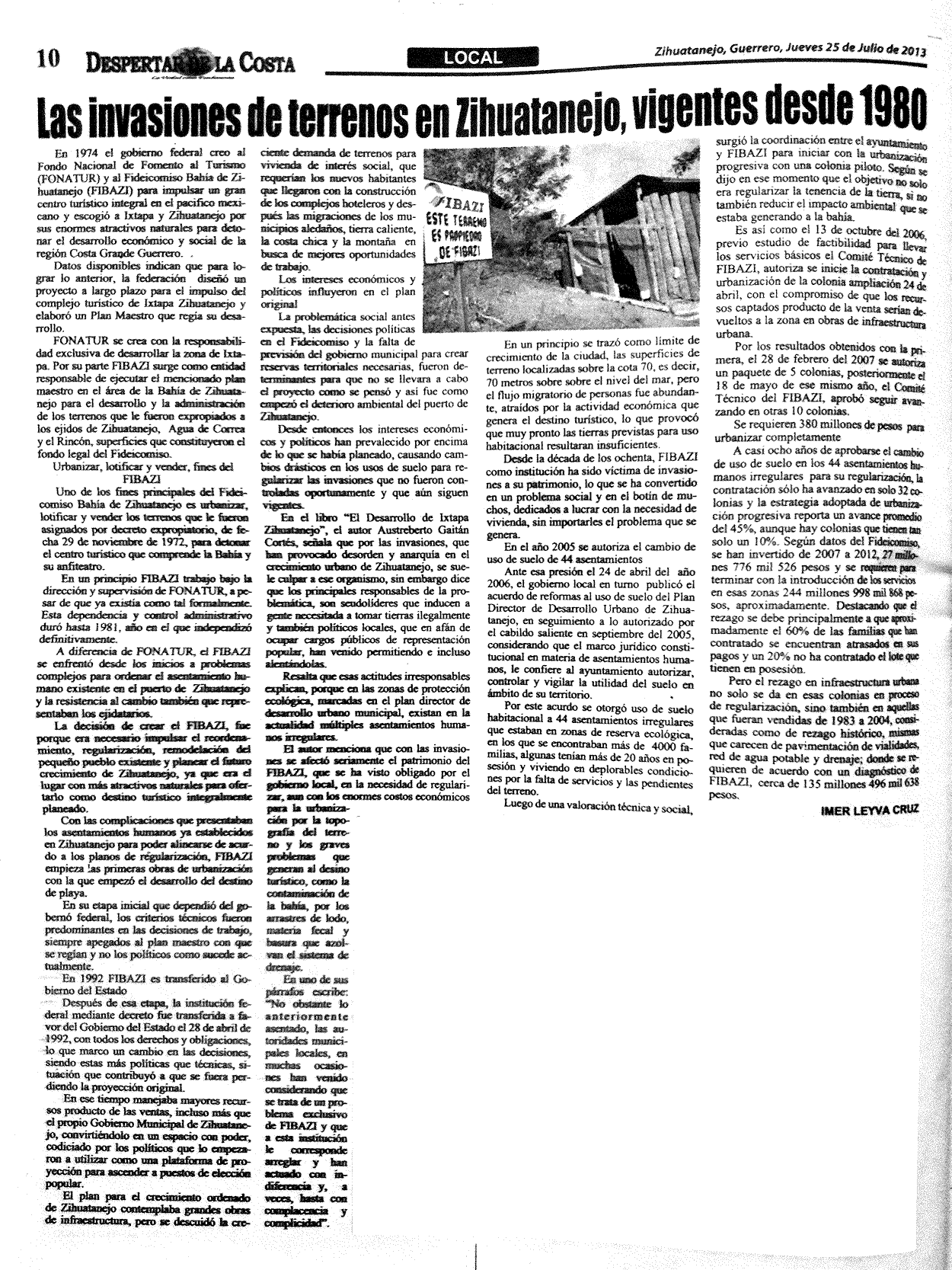
Este es un excelente artículo sobre cómo Fibazi llegó a existir aquí en Zihuatanejo y qué papel ha tenido con las invasiones. Personalmente creo que Fibazi nunca se hubiera constituido y que ha hecho más daño que bien a la comunidad de Zihuatanejo. Ahora los invasores están reclamando sus "derechos" exigiendo servicios y quejándose de que el gobierno los quiere bajar de los cerros sólo para vender los terrenos a extranjeros. Casi es chistoso cuando delincuentes reclaman derechos. Casi. La verdad es que en muchos casos estos invasores son vividores, y venden y traspasan las escrituras recibidas buscando lucrar y repetir el proceso con otra invasión.
Una historia de las invasiones y Fibazi
Its tough living up in those hills. Great view of the bay. But some essential services are still lacking for the poorest.
Una historia de las invasiones y Fibazi
by ZihuaRob , Zihuatanejo, México, Tuesday, July 30, 2013, 14:54 (4860 days ago) @ Esteban
Its tough living up in those hills. Great view of the bay. But some essential services are still lacking for the poorest.
You are confusing the "poorest" with the "manipulated" and the "cunning".
And hopefully the invasores will NEVER get those "essential services", though there are always slimebags in government seeking to find a following and a foothold on POWER & INFLUENCE who will help land thieves in return for all kinds of favors, including selling them their land for a bargain once they receive the title, and then there are the well-meaning but misguided foreigners who helped in part to fuel the latest mass invasion around 10 years ago where we went from something like 23 to 52 colonias irregulares in less than 3 years. Some are still helping and they really should know better by now.
But the state and municipal governments both know they need to get those folks down off the hillsides, and that's why they are dragging their feet on campaign promises and letting months go by without any water for the ones who managed to get it installed albeit provisionally.
I'm all for helping disadvantaged folks find affordable housing and using our taxes to help build them cheap homes on land outside the Zihuatanejo anfiteatro where it won't be so expensive to supply their homes with basic services. First we need to separate the truly needy from the scalliwags, of which there are hundreds if not thousands currently on our hillsides, each one of them keenly aware they are lawbreakers.
Una historia de las invasiones y Fibazi
This is a common issue in Mexico (and other LATAM countries). Property rights (the bundle of sticks) in US and most of Europe are deeply rooted in Common law...not so much in Mexico...where many times squatters are given some sort of rights.
I live in DF and have learned many of the areas in and around DF were "developed" by squatters (invasores) and eager politicians using creative re-zoning to garner votes and influence (as Rob describes very well).
Una historia de las invasiones y Fibazi
Despertar de la Costa seems to be running a series on the issue. I have a question from anyone who may know ...
It has been reported that some of the folks protesting for services and against relocation are accusing the mayor, Eric Fernández Ballesteros, of also living in this (un)"protected" zone. Is there truth to that?
Una historia de las invasiones y Fibazi
Kind of like puttin' toothpaste back in the tube.
Una historia de las invasiones y Fibazi
by ZihuaRob , Zihuatanejo, México, Tuesday, July 30, 2013, 20:07 (4860 days ago) @ carl
You misread what was poorly written. The demonstrators apparently made a protest banner saying in effect they'll come down from their hills when Eric comes down from his. They are referring to the hill at La Madera in front of Playa Caracol where his father built a modest vacation lodging back when he was presidente municipal.

Una historia de las invasiones y Fibazi
by ZihuaRob , Zihuatanejo, México, Tuesday, July 30, 2013, 20:09 (4860 days ago) @ Lee@98223
Kind of like puttin' toothpaste back in the tube.
More like giving back what you stole.
Una historia de las invasiones y Fibazi
Thanks for the clarification. That makes a lot more sense to me now.
Perhaps you would be so kind as to help me better understand another phrase also used in the same newspaper?
"Ya que, agregó que en Zihuatanejo hay colonias más accidentadas y que ya están regularizadas, como la Vicente Guerrero. “Lo que no hay es voluntad del municipio y ni de FIBAZI”, remarcó, en campaña si prometían soluciones y ahora es joder al jodido”.
In particular, the word joder I tend to avoid using but here I find it used in a newspaper. What's the clearest translation of "joder al jodido" in English?
Una historia de las invasiones y Fibazi
by ZihuaRob , Zihuatanejo, México, Wednesday, July 31, 2013, 08:16 (4860 days ago) @ carl
Thanks for the clarification. That makes a lot more sense to me now.
Perhaps you would be so kind as to help me better understand another phrase also used in the same newspaper?
"Ya que, agregó que en Zihuatanejo hay colonias más accidentadas y que ya están regularizadas, como la Vicente Guerrero. “Lo que no hay es voluntad del municipio y ni de FIBAZI”, remarcó, en campaña si prometían soluciones y ahora es joder al jodido”.
In particular, the word joder I tend to avoid using but here I find it used in a newspaper. What's the clearest translation of "joder al jodido" in English?
"Screw over the (already) screwed" - but I'm sure you really already knew that. 
Una historia de las invasiones y Fibazi
but I'm sure you really already knew that.
Thanks for the Mexican Spanish lesson! I sorta knew but on the other hand, I'm still not 100% clear on it. As I'm sure you know, Spanish word usage and meanings can vary depending on what country you're in. In some South American countries (Venezuela, for example), if you ask for a sandia no one would know what your talking about as the word is patilla. Likewise, as a guy, you tend not to tutear amongst other casual male friends as it can be connotative of being gay. The word chingar is understood but joder seems to be more typical. But both words are considered equally offensive.
Would it be correct to assume that in Mexican Spanish joder is more or less synonymous to chingar however not as offensive? Or are both words something to avoid using unless you are absolutely certain of your audience?
Thanks in advance!
Spanish 101.1
by ZihuaRob , Zihuatanejo, México, Wednesday, July 31, 2013, 11:40 (4859 days ago) @ carl
The Spaniards particularly seem to like to use joder to mean "to screw", pretty much with the same social acceptation as "screw" has in English. In Mexico it is the more socially acceptable form of chingar, though it will still make women blush and men smirk.


